

Blog
7 Best Codeless Automation Testing Tools in 2026

Published on
April 13, 2026
Compare the 7 best codeless test automation tools across self-healing accuracy, natural language authoring, & enterprise scalability to find the right fit.
Most tools that call themselves codeless still require code somewhere. A recorder-generated script breaks and someone opens a terminal. A visual flow works until an API call needs custom logic and a developer is pulled in. A no-code interface hides the script rather than eliminating it.
True codeless test automation is different. It means writing tests in natural language or through visual interaction, having the platform handle everything beneath that layer, and never needing a developer to keep the suite running. This page covers seven platforms that genuinely deliver on that standard, what each one does well, where each one has limits, and how to choose between them.
Before comparing tools, it helps to define the term precisely. Many platforms market themselves as codeless or low-code while still requiring scripting for anything beyond simple scenarios. True codeless automation meets all four of these criteria:
Tools that fail any of these criteria are low-code, not truly codeless. The distinction matters because the maintenance burden of low-code test tools at scale approaches that of fully scripted frameworks.
Best for: Enterprise teams needing AI-native test automation with self-healing and natural language authoring
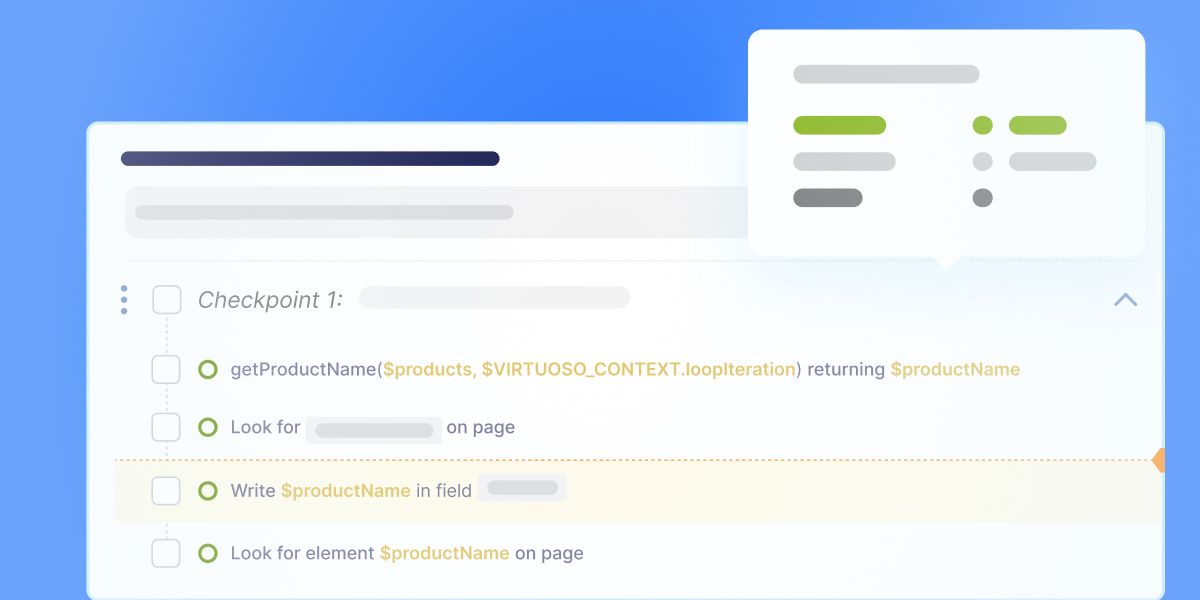
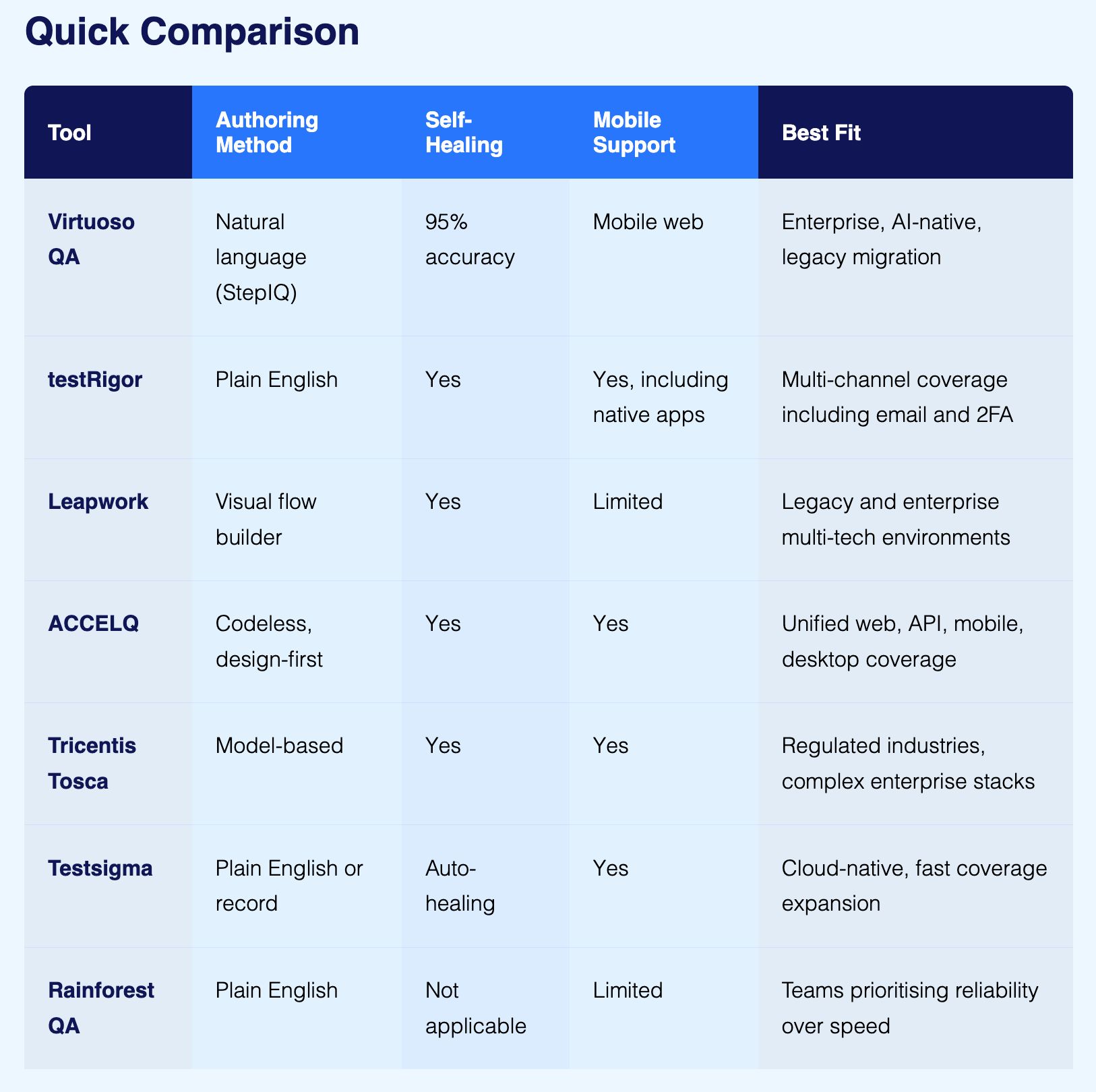
Virtuoso QA is built from the ground up as an AI-native platform, meaning intelligence is the architecture rather than a feature layer added on top. Tests are authored in plain English through the StepIQ engine. A QA analyst writes "Add product to cart, proceed to checkout, and complete payment with saved card" and the platform converts that into an executable, self-healing automated test without any scripting.
What separates Virtuoso QA from other codeless tools is what happens after the test is written. Virtuoso QA's self-healing engine achieves approximately 95% accuracy in automatically adapting tests when the application's UI changes. When a button moves, a class name changes, or a page is restructured, the test updates itself. Teams that previously spent the majority of their automation time repairing broken scripts report the opposite experience with Virtuoso QA.
The Virtuoso QA's GENerator capability converts legacy test assets including Selenium scripts, Tosca test cases, BDD Gherkin scenarios, and manual spreadsheets directly into executable natural language tests, removing the most common barrier to adopting a new platform without rebuilding from scratch.
Key capabilities:
Consideration: Virtuoso QA focuses on web-based applications. Teams with significant native mobile testing requirements outside of mobile web may need to complement it for those specific scenarios.
Pricing: Contact sales for enterprise pricing. Consumption and capacity-based subscription models available.
Best for: Teams that want plain English test creation with broad coverage including mobile and email validation
testRigor allows testers to write tests in plain English and execute them without managing any underlying scripting. Its approach is genuinely codeless: tests are written as natural language instructions, and the platform handles element identification, synchronisation, and execution without exposing any technical layer to the test author.
testRigor's coverage breadth is a notable differentiator in this category. Beyond standard web UI testing, it handles two-factor authentication flows, email and SMS validation, PDF and file download verification, and mobile testing on physical devices. This makes it practical for teams that need to validate complete user journeys that cross multiple channels rather than staying within the browser boundary.
Key capabilities:
Consideration: testRigor's pricing model, which charges for infrastructure rather than users or executions, can make cost estimation less predictable at scale compared to capacity-based models.
Best for: Enterprise teams testing across diverse technology stacks including legacy systems
Leapwork uses a visual, flow-based approach to test creation where testers build test scenarios by connecting blocks in a diagram interface rather than writing code or scripts. This visual model makes Leapwork accessible to non-technical users while supporting testing across a wide range of technologies including web, desktop, SAP, Citrix, and mainframe applications.
For enterprises with heterogeneous technology landscapes where a single platform must cover both modern web applications and legacy enterprise systems, Leapwork's technology breadth is a practical advantage over tools that focus exclusively on web.
Key capabilities:
Consideration: The visual flow interface, while accessible, can become complex to manage at scale when hundreds of flows are interconnected. Teams transitioning from natural language platforms sometimes find the visual model more rigid than they expected.
Best for: Teams needing unified codeless coverage across web, API, mobile, and desktop in a single platform
ACCELQ is a codeless automation platform that covers the full quality lifecycle from test design through execution without requiring programming expertise at any stage. Its design-first approach builds modularity into test architecture from the start, which reduces the accumulation of fragile, hard-to-maintain test assets over time.
A practical differentiator is ACCELQ's automated test case generation, which analyses Salesforce data models, API schemas, and application structures to suggest and generate test cases without manual specification. For teams maintaining large test portfolios, this reduces the effort of keeping coverage aligned with application evolution.
Key capabilities:
Consideration: Integrating ACCELQ with highly customised legacy systems or non-standard enterprise architectures may require additional configuration effort. Teams whose testing scope extends to very complex mainframe or desktop environments may find coverage limits.
Best for: Large enterprises with regulated industry requirements and complex multi-application testing
Tricentis Tosca uses a model-based test automation approach that creates a dynamic representation of application elements rather than relying on static scripts. The model adapts when applications change, providing resilience that scripted frameworks cannot match. Tosca is particularly strong in regulated industries such as financial services, healthcare, and insurance, where compliance documentation, audit trails, and formal test governance are mandatory.
Tosca's technology breadth is its clearest competitive advantage. It covers SAP, Salesforce, Oracle, web, mobile, API, and mainframe applications within a single platform, making it one of the few tools capable of serving genuinely complex enterprise landscapes where a single test suite must span fundamentally different technology layers.
Key capabilities:
Consideration: Tosca carries significant implementation investment in time, cost, and training. Teams without prior experience with model-based testing typically face a meaningful learning curve before achieving productive output, and licensing costs position it at the upper end of the market.
Best for: Teams wanting cloud-native codeless automation with rapid test creation across web, mobile, and API
Testsigma is a cloud-native test automation platform that enables test creation in plain English or through recording user actions. Its focus on speed of test creation, claim of being up to five times faster than traditional approaches, and support for 3,000+ real browsers and devices on the cloud make it a practical option for teams that need to scale coverage quickly without infrastructure overhead.
Testsigma's auto-healing capability detects element attribute changes and remaps tests with alternative locators automatically, reducing the maintenance effort that consumes QA capacity in script-based programmes.
Key capabilities:
Consideration: Testsigma's self-healing capability, while effective for common element changes, may require manual intervention for more complex structural changes to the application. Teams with very high release velocity should validate healing accuracy in their specific environment before full adoption.
Best for: Product and QA teams that want fast, reliable end-to-end testing without building or maintaining automation scripts
Rainforest QA takes a distinct approach to codeless testing: tests are written in plain English, and the platform executes them using a combination of AI-powered automation and, where needed, crowd-sourced human testers. This hybrid model means that even edge cases and visually complex scenarios that pure automation struggles with can be validated reliably.
For teams that have previously experienced the trust erosion that comes from flaky automated test suites, Rainforest's approach offers a practically zero-flakiness guarantee by routing genuinely ambiguous scenarios to human validation rather than producing unreliable automated results.
Key capabilities:
Consideration: The hybrid human-AI execution model, while reliable, means test execution time is longer than fully automated platforms and pricing scales with execution volume rather than users. Teams requiring very rapid feedback cycles within CI/CD pipelines should evaluate response times against their release cadence.


Try Virtuoso QA in Action
See how Virtuoso QA transforms plain English into fully executable tests within seconds.
