

Blog
15 Best End-to-End Testing Tools and Frameworks in 2026

Published on
May 10, 2026
Compare the best end-to-end testing tools for 2026. See which E2E platforms and frameworks deliver faster coverage, lower maintenance, and better ROI.
End-to-end testing has become the definitive measure of software quality. While unit and integration tests validate individual components, only comprehensive E2E testing proves that complete business processes work from user interface through APIs to databases and back. Yet most organizations struggle with E2E testing complexity, creating either brittle automated suites requiring constant maintenance or relying on manual testing that cannot keep pace with continuous delivery demands. This comprehensive analysis examines leading E2E testing solutions, divided into adoption-ready platforms and developer-centric frameworks, revealing why AI native architectures now deliver business process validation at speeds and scales impossible with traditional code-based approaches.
The E2E testing market divides into two fundamentally different categories: platforms you can adopt quickly for immediate productivity, and frameworks requiring significant development investment.
Platforms provide complete solutions for end-to-end testing with minimal setup. They include test authoring interfaces (often codeless or low-code), execution infrastructure (cloud-based browsers and devices), reporting and analytics, integration with CI/CD pipelines, and test management capabilities. Organizations can begin creating and executing E2E tests within days of adoption.
AI native platforms like Virtuoso QA take this further, offering autonomous test generation that creates comprehensive E2E suites from requirements, natural language authoring that eliminates coding entirely, self-healing that maintains tests automatically as applications change, and unified testing that validates UI and API interactions in single scenarios.
The value proposition centers on speed and democratization. Business analysts who understand workflows can create E2E tests without engineering degrees. Manual testers can convert their domain expertise directly into automated validation. QA teams expand testing capacity without proportional headcount increases because the platform handles technical complexity through AI.
Frameworks provide libraries and APIs that engineers use to build custom test automation. Selenium, Cypress, Playwright, and similar tools give developers control over every aspect of test execution but require writing code for test scenarios, building reporting infrastructure, creating CI/CD integrations, and developing maintenance processes.
This approach appeals to organizations with strong development cultures where engineers own quality. The flexibility enables precise control for complex technical scenarios. However, the investment is substantial. Building comprehensive E2E test coverage with frameworks typically requires dedicated automation engineering teams, months of initial development, and ongoing maintenance consuming 80% of effort as applications evolve.
The critical question for organizations: does the control justify the cost? For most enterprises, the answer is increasingly no. AI native platforms now deliver equivalent or superior E2E validation without the engineering investment, enabling faster time to value and better testing economics.
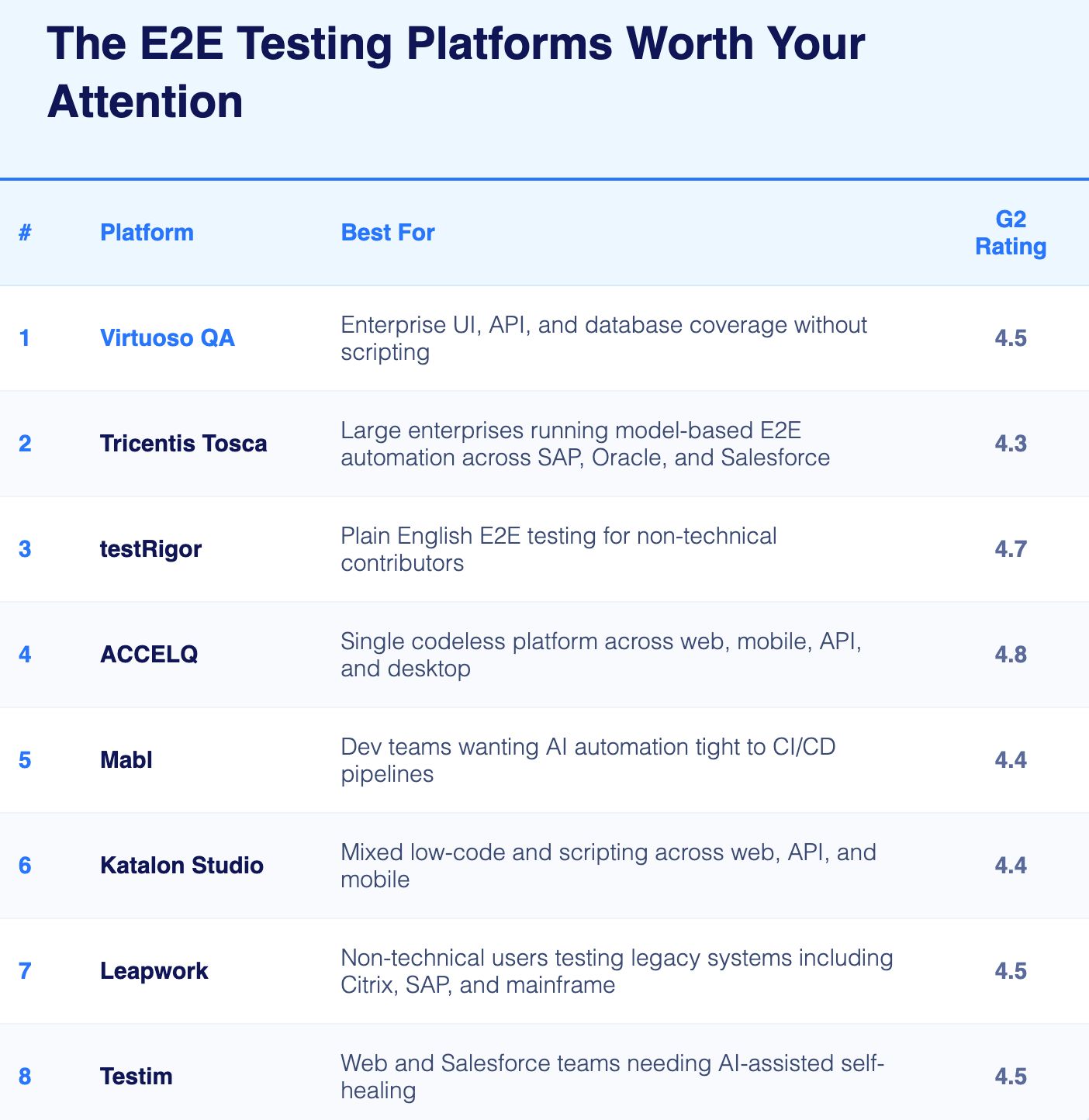
Virtuoso QA is built from the ground up as an AI-native platform, not a traditional framework with AI features layered on top. Tests are authored in plain English through Natural Language Programming, making coverage accessible to QA engineers, business analysts, and product owners alike. When the application changes, Virtuoso QA's self-healing engine adapts tests automatically rather than breaking and waiting for a human fix.
Best for: Enterprise teams that need AI-native end-to-end coverage across UI, API, and database without scripting or specialist engineering
Watch the video below to see how Virtuoso QA is used to author robust end-to-end tests for an insurance application, demonstrating how complex business workflows can be automated quickly and reliably.
Tricentis Tosca is one of the most established enterprise continuous testing platforms in the market. Its model-based approach generates E2E tests from business process definitions rather than element locators, making it accessible to business-side contributors who understand the process but not the technology underneath it.
See Virtuoso QA vs Tricentis Tosca for a side-by-side enterprise E2E testing comparison.
testRigor interprets test instructions at the functional level, which means E2E workflows are described the way a manual tester would write them. It handles multi-step journeys across login flows, form submissions, checkout processes, and verification steps without requiring selector management or scripting knowledge.
ACCELQ's model-based approach allows teams to define E2E business processes as reusable test flows. A single end-to-end scenario can chain web UI steps, API calls, and desktop interactions together, which is relevant for enterprise applications that span multiple interfaces and layers.
Mabl covers E2E testing across browser UI and API layers within a single low-code environment. Its integration with CI/CD pipelines means E2E suites trigger on every commit, and its self-healing keeps those suites running without constant manual intervention as the application evolves.
Katalon supports E2E testing by combining UI, API, and mobile test execution in one environment. A single E2E scenario can validate a web journey, call an API, and verify a mobile outcome without switching between tools. It wraps Selenium and Appium in a more accessible layer while preserving the option to write code when business processes require it.
Refer to our Virtuoso QA vs Katalon for a detailed analysis of Katalon Studio and AI-native E2E testing platforms like Virtuoso QA.
Leapwork replaces scripts with visual flowcharts, making E2E test creation genuinely accessible to people who cannot read code. Its ability to reach Citrix, SAP GUI, and mainframe interfaces is a specific differentiator for organisations with older technology estates where most modern E2E platforms cannot operate.
For a detailed comparison, refer to our Virtuoso QA vs Leapwork page.
Testim builds on industry-standard WebDriver but adds a machine learning layer that reduces the manual effort of keeping tests current. Tricentis ownership provides enterprise stability and a broader quality ecosystem for larger organisations.
Refer to our Virtuoso QA vs Testim comparison page for a detailed analysis of architectural differences and enterprise end-to-end testing capabilities.

The most widely used E2E automation framework with approximately 62% market share. Selenium gives engineering teams complete control over how E2E coverage is built but places full responsibility for maintenance, reporting, and stability on the team.
Cypress runs E2E tests inside the browser alongside the application, eliminating WebDriver round-trip latency and most timing-related failures. Strong developer experience but deliberately narrow in scope.
Playwright represents the current state of the art for code-first E2E automation. Browser contexts allow fully isolated parallel test runs, and the trace viewer makes investigating E2E failures significantly faster than older frameworks.
Robot Framework abstracts E2E automation behind a keyword layer, making test files readable without programming knowledge. The engineering complexity moves into keyword libraries rather than disappearing, but the resulting E2E test files communicate business intent clearly.
Cucumber makes the connection between business requirements and automated E2E tests visible through Gherkin syntax. E2E scenarios serve as living documentation all stakeholders can read, though engineering complexity still exists behind the readable surface.
WebdriverIO supports both WebDriver protocol and Chrome DevTools from a single API, and its native Appium integration extends E2E coverage to iOS and Android without a separate framework. One of the most versatile JavaScript-based E2E options available.
Appium is the foundational open-source standard for cross-platform mobile E2E automation. It abstracts iOS and Android testing frameworks behind a unified WebDriver API, letting teams write E2E tests once and run them on both platforms without maintaining separate codebases.

Selecting the right approach for end-to-end testing requires evaluating platforms and frameworks against organizational needs, constraints, and strategic objectives.
End-to-end testing must validate complete workflows spanning multiple systems. Evaluate whether platforms support unified UI and API testing in single scenarios, enable testing across multiple applications and integrations, provide data validation capabilities for database and backend verification, and handle complex workflows including conditional logic and error handling.
Platforms offering unified business process validation deliver superior value compared to frameworks requiring separate tools for UI, API, and data testing, then manual correlation of results.
Creating comprehensive E2E test coverage for enterprise applications with traditional frameworks requires months of engineering effort. Platforms like Virtuoso with autonomous test generation capabilities create equivalent coverage in hours by analyzing applications, understanding workflows, and generating tests from requirements or existing manual test cases.
Evaluate generation capabilities through proof of concepts measuring time to create comprehensive E2E coverage for representative applications.
End-to-end tests touching multiple systems face exponential maintenance challenges. Platforms claiming self-healing should demonstrate specific metrics: percentage of application changes handled autonomously, accuracy of automatic adaptations, and customer references achieving significant maintenance reduction.
Virtuoso's proven 95% self-healing accuracy means only 5% of application changes require human intervention, fundamentally altering E2E testing economics compared to frameworks where 100% of changes demand manual updates.
Can business analysts, manual testers, and domain experts create and maintain E2E tests, or do platforms require specialized engineers? True codeless platforms dramatically expand E2E testing capacity by leveraging existing team members who understand business processes rather than depending on scarce automation specialists.
Evaluate democratization through proof of concepts where non-technical team members attempt E2E test creation. If they struggle or require extensive support, the platform has not truly eliminated coding requirements despite marketing claims.
Organizations using separate tools for UI testing (Selenium/Cypress/Playwright), API testing (Postman), visual testing (Applitools), and test management face fragmentation: tests exist in different systems, results require manual correlation, maintenance multiplies across tools, and teams must learn multiple platforms.
Unified platforms providing comprehensive E2E testing capabilities reduce complexity, consolidate licenses, simplify maintenance, and improve team productivity through single-platform expertise.
Modern E2E testing must integrate seamlessly with continuous delivery pipelines. Tests should trigger automatically on code commits, execute in parallel for speed, provide instant results to development teams, fail builds when critical E2E workflows break, and integrate with artifact repositories and deployment tools.
Evaluate integration quality through proof of concepts in actual CI/CD environments (Jenkins, Azure DevOps, GitLab CI, GitHub Actions) using representative E2E test suites.
Platform costs include licensing, implementation, infrastructure, ongoing maintenance, and personnel. Calculate three to five year TCO for E2E testing including all factors.
The cheapest option may yield highest TCO if maintenance burden remains high. Conversely, platforms with higher licensing costs but autonomous maintenance may deliver lowest TCO through dramatically reduced personnel requirements. Virtuoso customers achieving 88% maintenance reduction calculate ROI by comparing traditional framework costs (tools plus 10 SDETs maintaining E2E tests) against Virtuoso costs (platform plus 1-2 general QA staff), typically showing positive ROI within 12 months.
The E2E testing market is experiencing a fundamental transformation. Organizations still debating platform selection face the same decision enterprises confronted two decades ago about test automation itself: adopt now and gain competitive advantage, or delay and fall behind competitors who move faster with better quality.
Enterprise application complexity grows exponentially while business velocity accelerates. Applications integrate more systems, serve more users, deploy more frequently. Traditional E2E testing approaches cannot scale to match this complexity and speed.
Consider the mathematics. An enterprise with 50 applications, each releasing bi-weekly, faces 1,300 releases annually. If each release requires comprehensive E2E validation across critical business processes, the organization must execute tens of thousands of E2E test runs yearly. With traditional frameworks requiring human maintenance for every test, this becomes economically impossible.
AI native platforms transform the equation. Autonomous test generation creates comprehensive E2E coverage in days instead of months. Self-healing maintenance eliminates 88% of human intervention. Unified testing validates complete business processes spanning UI and API in single scenarios. Natural language authoring enables entire teams to create E2E tests. Parallel execution compresses runtimes from days to hours.
Suddenly, comprehensive E2E testing at enterprise scale becomes achievable with small, general QA teams rather than armies of specialized automation engineers.
Organizations adopting AI native E2E testing gain measurable competitive advantages. They release software faster because end-to-end validation no longer creates bottlenecks. They achieve higher quality because comprehensive automated coverage catches integration defects manual testing misses. They reduce costs because QA teams focus on expanding coverage rather than maintaining tests.
Most critically, they attract and retain superior talent. Skilled QA professionals prefer working with cutting-edge AI platforms that amplify their business process expertise rather than spending 80% of their time manually maintaining brittle framework-based E2E tests.
Moving from traditional frameworks to AI native platforms requires strategic planning but delivers rapid returns. Organizations should identify high-value applications where E2E testing creates clear bottlenecks, conduct proof of concepts using actual application environments, measure results using objective metrics (maintenance reduction, test creation velocity, coverage expansion), calculate ROI comparing framework TCO against AI native platform TCO, and plan phased migration using tools like GENerator to convert existing E2E test assets.
The transition typically shows ROI within 6 to 12 months as maintenance burden reduction creates immediate cost savings and velocity gains. Organizations delaying adoption face growing competitive disadvantage as competitors move faster with better quality at lower costs.

Try Virtuoso QA in Action
See how Virtuoso QA transforms plain English into fully executable tests within seconds.
